
01 / 08
Why the Contaminant Must Be Named
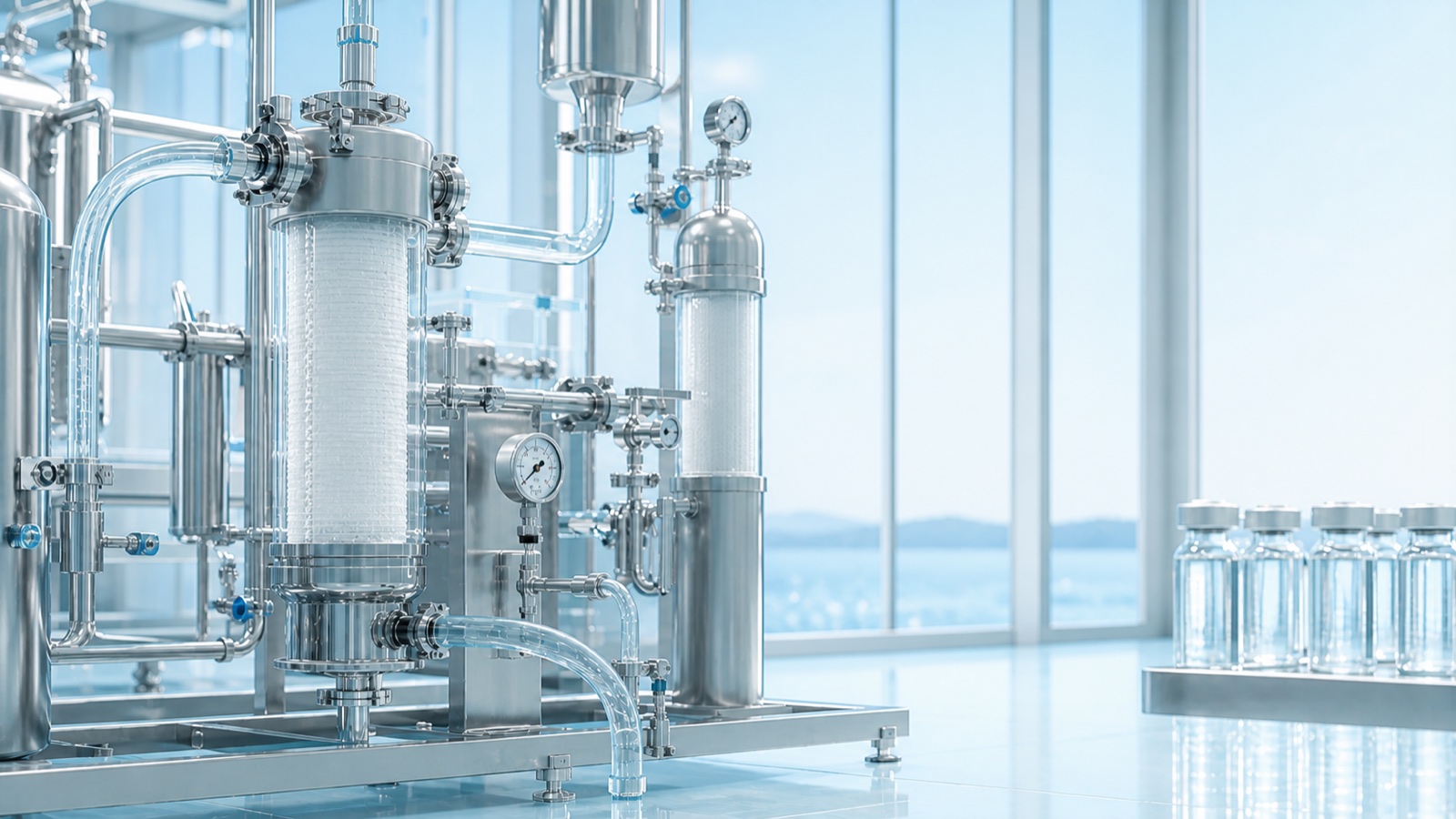
“Particulate matter” in a pharmaceutical plant can mean a visible glass fragment, a subvisible silicone-oil droplet, a protein aggregate, a bacterium or a piece of elastomer. These species carry different risks and behave differently in a filter. Pleated cartridges provide high area for buffers, intermediates, solvents and final solutions. Presterilized capsule filters create a closed, disposable path for clinical batches, biologics, vaccines, ophthalmics and other low- to medium-volume operations. Selection must be based on the product, contaminant, compatibility, adsorption risk and validated retention duty.
02 / 08
Stage 1: Raw Materials, Solvents, Buffers and Water
Incoming liquid ingredients can contain bag or drum fibers, packaging debris, undissolved excipient, activated-carbon fines, ion-exchange resin beads, rust, precipitated salts and gasket fragments. Buffer make-up can introduce undissolved sodium chloride or phosphate crystals. Water systems can contribute corrosion oxides, scale particles, biofilm fragments and microorganisms. A pleated prefilter or capsule can remove suspended material before it reaches a mixing vessel, chromatography column or final membrane.
The limitation is equally important. Dissolved ions, residual solvents, endotoxin and most soluble chemical impurities pass through ordinary microfiltration. FDA has cautioned that a sterilizing filter should not be used to mask a microbiological or endotoxin problem in a Water for Injection system.[1] These risks require source control and appropriate purification technologies.
03 / 08
Stage 2: Small-Molecule Synthesis and Liquid Formulation
Chemical synthesis streams may carry catalyst particles, activated carbon, filter-aid carryover, crystallized API, insoluble reaction by-products, pipe scale and corrosion debris. During formulation, incomplete dissolution can leave API or excipient crystals; pH or temperature shifts can trigger precipitation. Filtration can polish a true solution, but it may be the wrong operation for a suspension drug whose particles are intentional.
A key production difficulty is compatibility. Strong solvents, high or low pH and concentrated surfactants can swell seals, alter membrane wetting or increase extractables. Product recovery must also be measured: an adsorptive membrane can bind a low-dose API or preservative. Validation should use the real formulation at worst-case concentration, temperature, pressure and contact time.
04 / 08
Stage 3: Fermentation, Cell Culture and Biologics Clarification
Harvest fluid can contain whole mammalian, bacterial or yeast cells; dead cells; cell-wall fragments; microcarriers; precipitates; lipids; and dense cell debris. Soluble host-cell proteins and DNA are also present, but they are not reliably removed simply because a pleated microfilter is installed. Clarification uses centrifugation, depth filtration or staged systems to reduce biomass and protect downstream purification. Sartorius identifies cells, cell debris, host-cell proteins and DNA as important harvest impurities and describes clarification as the initial removal step.[2]
Biologics add a recovery challenge. Viruses, vaccines and proteins can adsorb to filter media or be trapped with debris. High cell density can block a membrane quickly, while excessive shear can create more fragments. The process may need a depth prefilter followed by a pleated membrane, with media selected for low product binding. Chromatography, TFF and specific clearance steps still perform the soluble-impurity work.
05 / 08
Stage 4: Post-Purification and Final Sterilizing Filtration
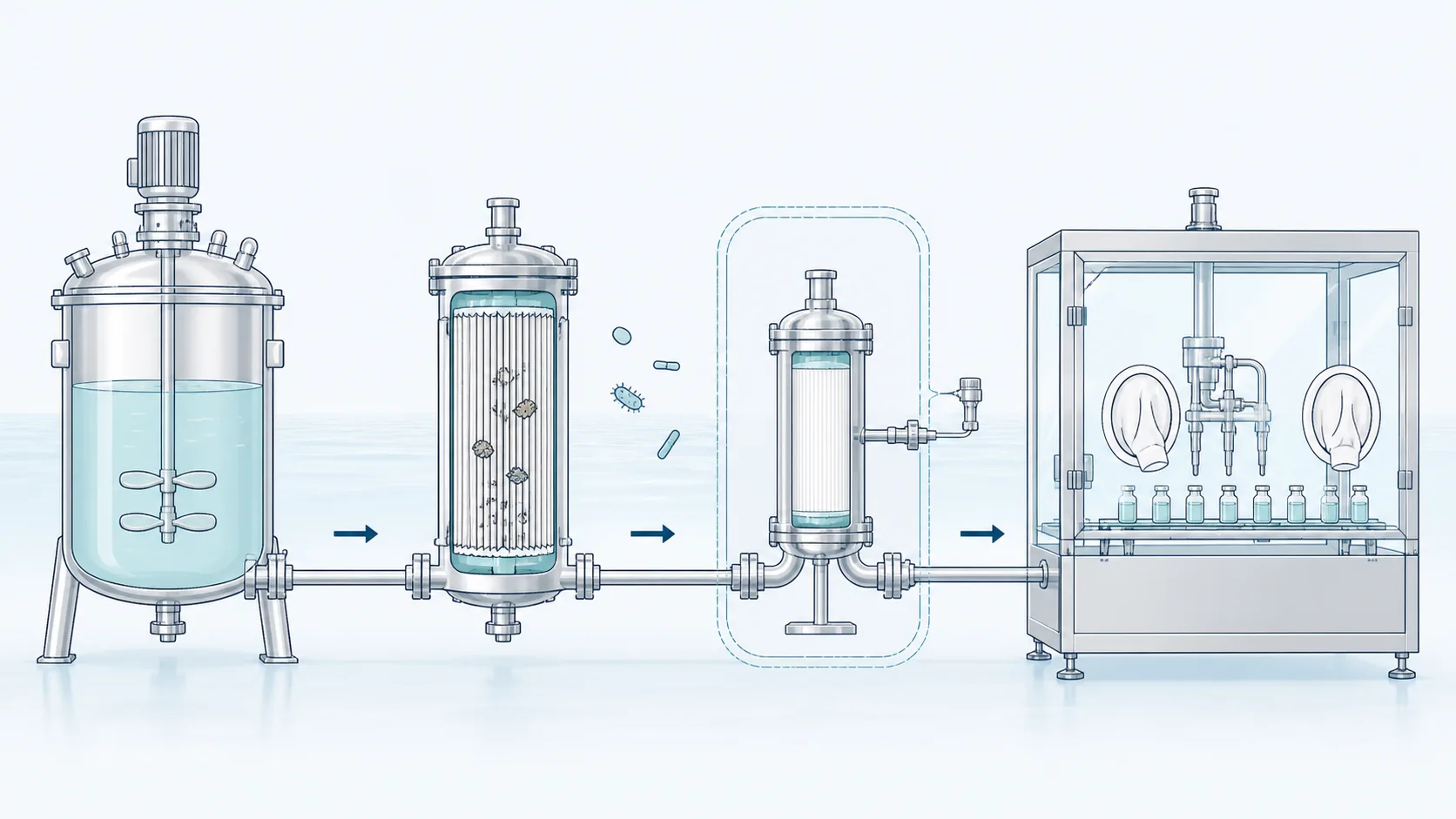
After purification, a formulation may still contain bacteria, environmental fibers, resin fines, protein aggregates, precipitated buffer salts and debris released by single-use connectors. A protective prefilter removes the aggregate and particle load. The final sterilizing-grade membrane controls viable microorganisms immediately before aseptic filling when the product cannot be terminally sterilized.
FDA guidance states that sterilizing-grade filters are usually rated 0.2 micrometer or smaller and should be validated with a microbiological challenge under worst-case production conditions; integrity testing and evaluation of product bioburden are part of that control strategy.[3] A 0.2-micrometer label alone is not proof of a sterile process. Filter area, flow decay, pressure, product interaction, microbial retention and pre- and post-use integrity results must be defined. Viruses, endotoxin and dissolved impurities are not automatically removed by this step.
06 / 08
Stage 5: Filling, Final Containers and Visible Particles
Final injectable products may show glass delamination flakes, rubber stopper fragments, cellulose fibers, stainless-steel particles, plastic fragments, silicone-oil droplets, proteinaceous particles or crystallized product. Some originate downstream of the final filter, so adding a tighter filter upstream cannot eliminate every source. FDA’s visible-particle guidance emphasizes a holistic strategy that includes product development, manufacturing controls, inspection, identification, investigation and prevention.[4]
This is the practical argument for source mapping. If particles are glass, review container chemistry and handling. If elastomeric, inspect pumps, valves and stoppers. If proteinaceous, investigate formulation, agitation, freeze–thaw and interfacial stress. If they are fibers, examine garments, wipes and transfer steps. Filtration is one control within that system, not a substitute for root-cause correction.
07 / 08
Choosing Between a Pleated Cartridge and a Capsule
A reusable stainless-steel housing with a pleated cartridge may suit large validated campaigns and high throughput. A capsule reduces assembly and cleaning, supports closed processing and can simplify changeover for multiple products. Capsules are especially valuable in development, final buffer filtration, sampling, media addition and final filtration of smaller batches. Both formats require compatible connections, venting and draining, an appropriate sterilization method, traceable materials and integrity-test limits.
The filtration train should be sized from solids load and flow decay, not only batch volume. A high-fouling feed often benefits from staged pore sizes or a depth prefilter. The final membrane should perform the critical retention duty rather than serve as the plant’s first clarification device.
08 / 08
Conclusion
Pharmaceutical cartridge filtration is strongest when every stage has a defined purpose. Raw-material filters remove fibers, crystals and equipment debris. Clarification reduces cells and cell fragments. Prefilters capture aggregates and protect the final membrane. Validated sterilizing-grade filters control microorganisms in compatible solutions before aseptic filling. Capsules add closed, disposable convenience; pleated cartridges provide scalable area. Neither format removes all soluble impurities, endotoxin or viruses, and neither corrects particles generated after filtration. A successful specification therefore links the named contaminant, process stage, patient risk and validation evidence.
Related search topics
- pharmaceutical cartridge filtration
- sterilizing grade capsule filter
- 0.2 micron pharmaceutical filter
- biopharmaceutical clarification
- liquid drug filtration
- protein aggregate prefilter
- cell debris removal
- aseptic processing filter
- single use capsule filtration
- injectable particulate control