
01 / 06
First Define the Stream: Liquid or Air
Laser manufacturing covers very different processes: laser cutting and welding, powder-bed fusion, resin-based additive manufacturing, optical-component coating, laser cooling and electrophotographic printing. Pleated liquid cartridges and disposable capsule filters apply to liquids such as cooling water, photopolymer resin, coating chemicals and some ink loops. They are not substitutes for local exhaust ventilation, HEPA filtration or gas-phase controls used for fumes, nanoparticles and vapors.
NIOSH identifies metal, ceramic and polymer powders, fumes and volatile organic compounds as additive-manufacturing hazards.[1] OSHA likewise treats laser-generated airborne contaminants as a ventilation and in-line exhaust-filtration issue.[2] This boundary protects both workers and the credibility of the equipment specification.
02 / 06
Laser Cooling Water and Chiller Loops
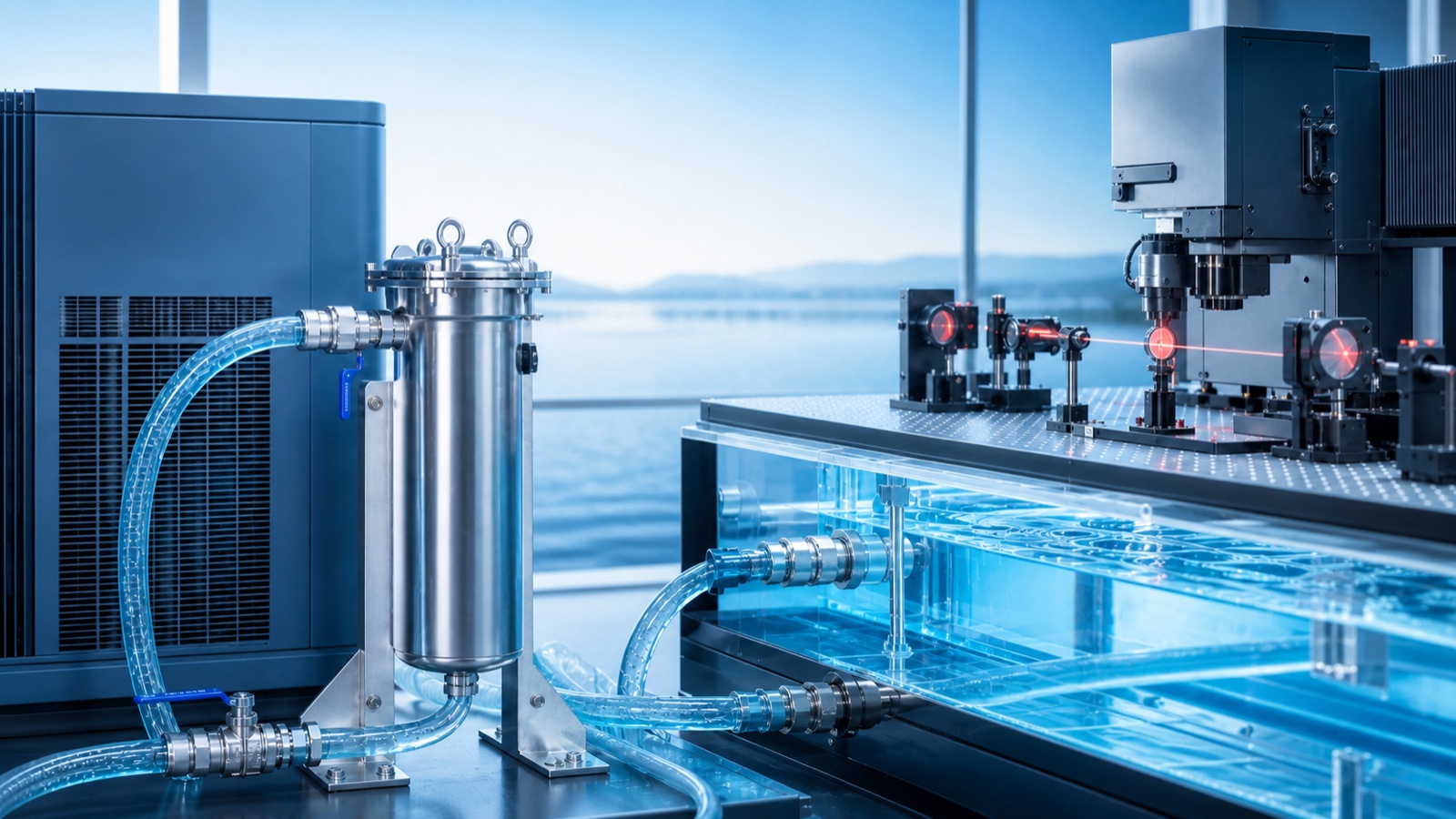
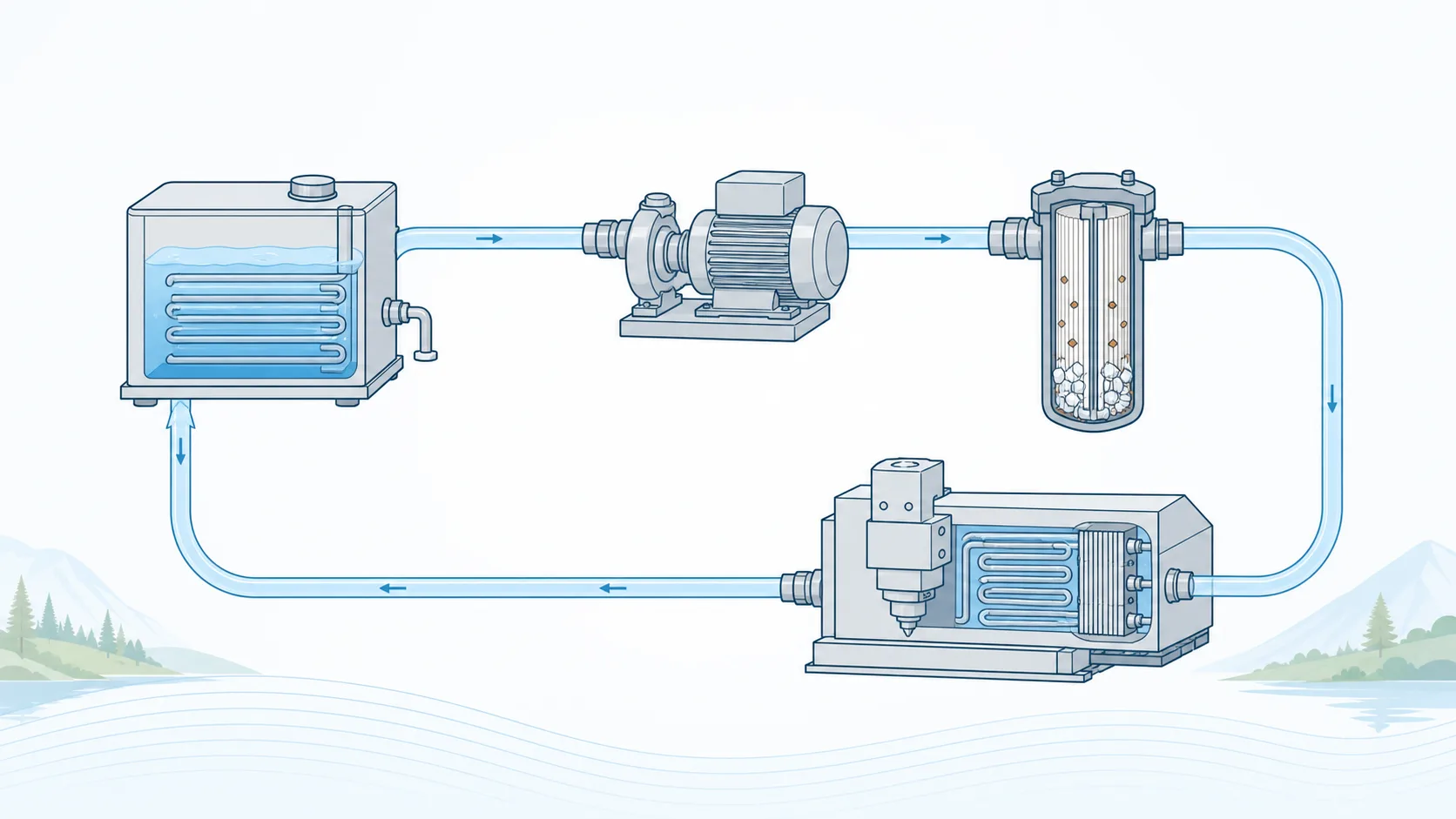
Closed cooling circuits can accumulate iron oxide rust, copper oxide corrosion, calcium carbonate scale crystals, silica, machining chips, pump-wear particles, elastomer fragments and biofilm flakes. These solids restrict narrow cooling channels, coat heat-transfer surfaces, damage seals and destabilize temperature control. A pleated cartridge in the main or side stream can reduce particulate loading; a compact capsule can protect an analyzer, dosing branch or sensitive point of use.
The difficult part is separating particles from dissolved problems. A cartridge can capture precipitated scale or corrosion products, but it does not remove dissolved hardness, ionic conductivity or dissolved organics. Water chemistry, corrosion inhibition, ultraviolet treatment or ion exchange may also be necessary. Filter materials must tolerate glycol, inhibitors, temperature and cleaning chemicals.
03 / 06
Photopolymer Resin and Laser-Based Additive Manufacturing
Stereolithography and related vat processes can leave partially cured resin gels, thin cured skins, support fragments, dust, fibers and pigment agglomerates in recovered resin. These contaminants may create surface pits, recoater marks, optical scattering or incomplete features. A low-shedding capsule can be useful for small-batch resin transfer; a pleated cartridge may serve a larger recovery loop.
Resin filtration is sensitive to viscosity and light exposure. Soft gels may deform, while stray ultraviolet light can generate new gel after filtration. Testing should use aged resin at operating temperature and verify that the media does not adsorb photoinitiator, dye or dispersant. The filter should be enclosed or shielded where required.
04 / 06
Optical Coatings, Photoresists and Laser-Material Jetting
Laser optics and photonic components use coating solutions, cleaning liquids, photoresists, developers and functional inks. Relevant contaminants include glass or polishing dust, silica particles, dried resin flakes, microgels, precipitated additives, lint, hair and seal fragments. These solids can create pinholes, scatter light or disturb a thin-film edge. Staged filtration—coarser protection followed by a fine point-of-use capsule—usually gives steadier flow than loading one ultrafine filter with every particle.
05 / 06
Laser Printers and Dry Powder Systems
Laser printers generate or handle dry toner composed of polymer resin, pigment such as carbon black, charge-control additives and flow aids such as silica. Paper fibers, toner dust and polymer fragments are dry contaminants. Metal additive systems similarly handle fine metal powder. These streams require enclosed handling, housekeeping and suitable air or powder-control equipment. NIOSH reports that high-energy processes, including laser cutting and 3D printing, can generate nano- and microplastic emissions.[3] A standard liquid capsule filter should never be presented as the control for those airborne particles.
06 / 06
Conclusion
Laser manufacturing liquid filtration is most useful in cooling circuits, resin recovery, coating chemicals and functional-fluid delivery. It removes rust, scale crystals, wear debris, cured resin, gels, fibers and agglomerates that threaten channels or precision surfaces. Airborne toner, metal powder, smoke and ultrafine emissions belong to a separate extraction strategy. By defining the stream, contaminant and failure mode first, manufacturers can place pleated cartridges and capsules where they genuinely improve uptime and product quality.
Related search topics
- laser manufacturing liquid filtration
- laser chiller water filter
- photopolymer resin capsule filter
- SLA resin filtration
- laser cooling loop cartridge
- optical coating filtration
- photoresist capsule filter
- laser printer toner filtration
- additive manufacturing contamination control
- pleated filter for laser equipment