
01 / 06
Why a Small Particle Becomes a Large Printing Defect
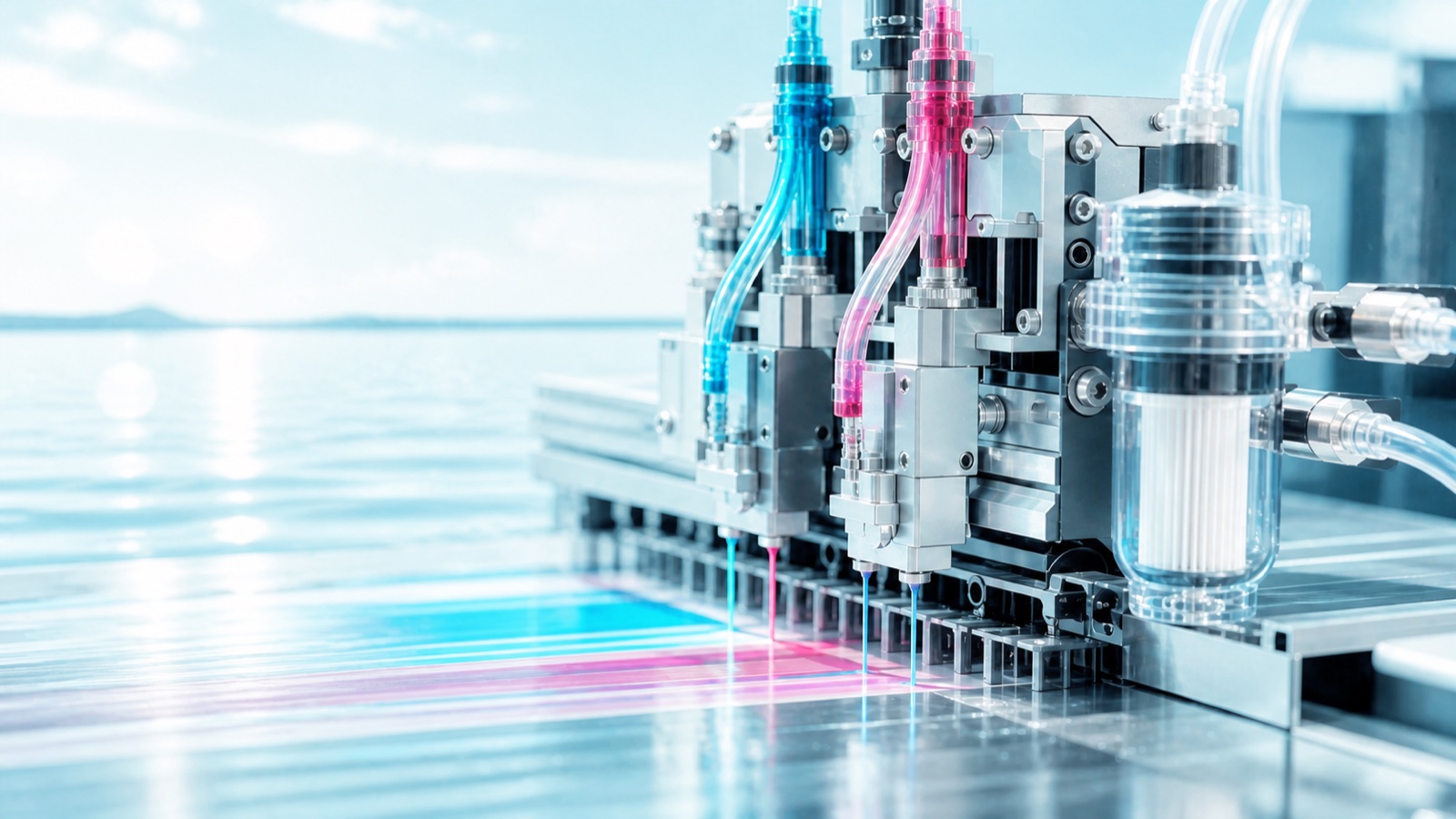
Inkjet printheads meter fluid through narrow channels and nozzles. A single oversized particle or deformable gel can cause nozzle dropout, jet deflection, banding or inconsistent drop volume. In gravure, flexographic, screen and coating operations, the same contaminants can create streaks, craters, pinholes, doctor-blade lines and rough surfaces. Pleated cartridges provide area for batch transfer and recirculation, while disposable capsules are widely suited to last-chance filtration near a printhead, coater or filling point.
The filtration target is not “all particles.” Pigment inks, conductive inks and filled coatings intentionally contain carbon black, titanium dioxide, organic pigments, metal flakes, ceramic particles or polymer beads. Removing the functional fraction changes color strength, conductivity, opacity, cure and rheology. The job is to control oversized and foreign material.
02 / 06
Water-Based and Solvent-Based Inks
Typical unwanted solids include pigment agglomerates, undispersed resin, dried ink skins, tank scale, rust, paper fibers, lint, gasket fragments and environmental dust. Solvent evaporation around tank walls can create hard flakes; incompatible resins can precipitate after blending; poor dispersion can leave a long tail of large pigment clusters. These populations may change during storage, pumping and recirculation.
A coarse protection stage removes fibers and skins before a finer pleated filter. A low-hold-up capsule close to the printhead captures last-chance debris created downstream by pumps, hoses or connectors. The membrane must be chemically compatible and low shedding. Adsorption testing matters because some media can remove dye, dispersant or binder and shift viscosity or color.
03 / 06
UV-Curable and Radiation-Curable Fluids
UV inks can form partially cured polymer gels when exposed to stray light, heat or reactive contamination. These soft particles deform through a filter differently from rigid calibration beads and can recover their shape downstream. Pall reports that UV-ink gels are often below 10 micrometers and can plug nozzles or create coating defects.[1] Other targets include cured resin flakes, photoinitiator precipitate, pigment clusters and dust.
The production difficulty is time dependence. A freshly blended ink may pass easily, while the same batch ages, polymerizes or develops gels after repeated thermal cycles. Validation should therefore include aged fluid, realistic temperature, line pressure and recirculation. An absolute rating based on a standardized challenge is more informative than an unsupported nominal label, but application testing remains essential.
04 / 06
Industrial Coatings, Varnishes and Functional Printing
Paints and coatings may contain titanium dioxide, silica matting agent, metallic flakes or conductive particles by design. Unwanted contaminants include oversize pigment agglomerates, crosslinked binder gel, dried wall skin, spray-booth debris, sanding dust, fibers and precipitated additive. Clear varnishes reveal tiny fibers and gels as visible defects; conductive or battery-related coatings can fail electrically if a foreign particle interrupts a thin functional layer.
A filter selected only by micron size may remove valuable flakes or plug immediately on a high-solids coating. The better approach is to define the maximum acceptable defect particle, compare it with the intentional particle distribution, and choose area and media geometry that preserve throughput.
05 / 06
Where Filters Belong in the Process
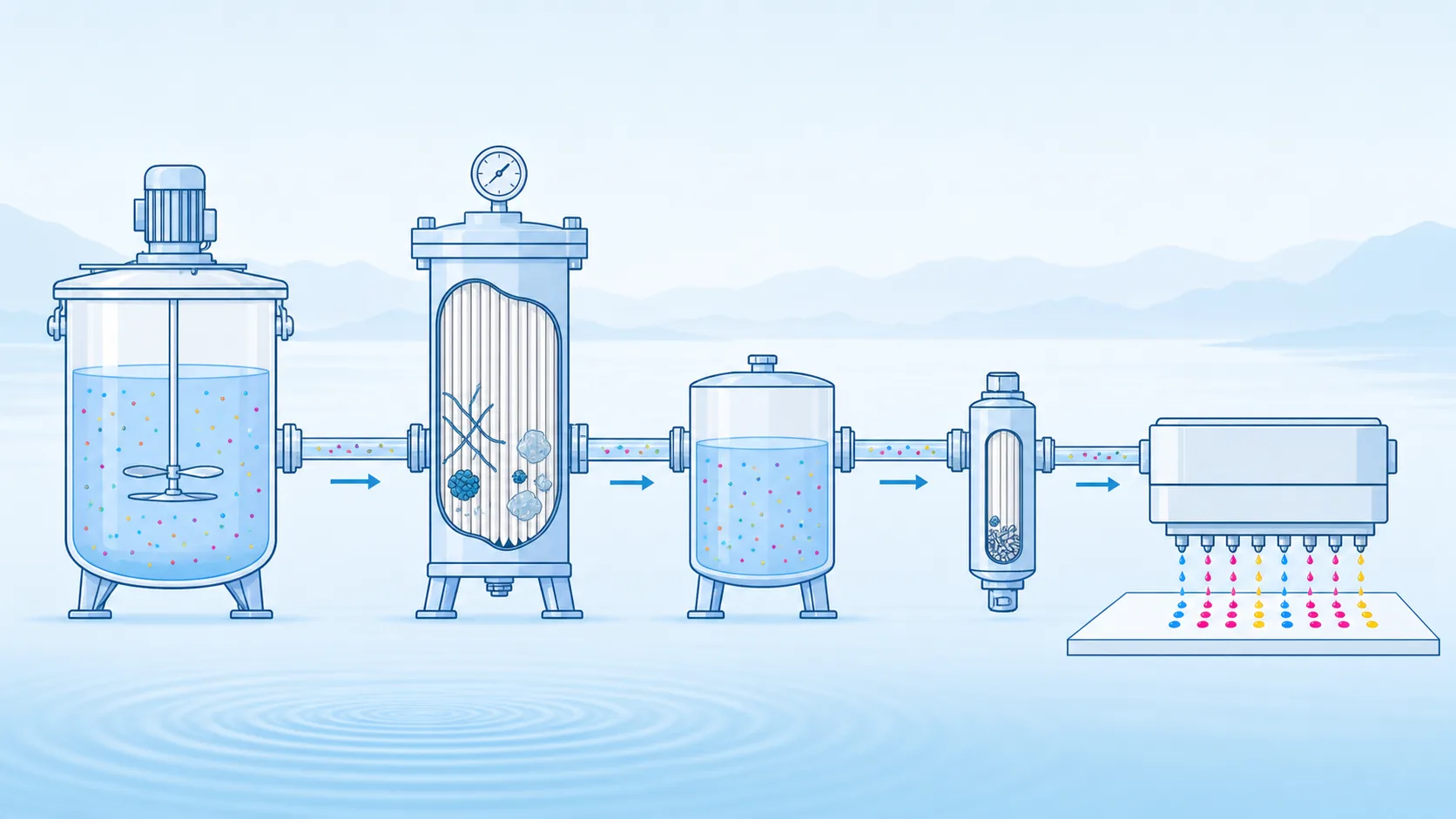
Bulk filtration after dispersion protects storage and filling. Transfer-line filtration captures tank and hose debris. Recirculation filtration controls particles generated during operation. A final capsule near the printhead or coating head catches downstream wear debris. Pall’s digital-printing guidance identifies large particles, fibers, gels, degradation products, environmental contamination and printer-component debris as practical targets, and recommends both bulk and last-chance locations.[2] Staging these duties prevents the finest filter from carrying the entire contamination load.
06 / 06
Conclusion
Reliable inkjet ink filtration is a balance between defect removal and formulation preservation. Pleated cartridges and capsules should target agglomerates, gels, skins, fibers, corrosion particles and component debris at the stage where they arise. The strongest specification combines particle analysis, chemical-compatibility testing, pressure and flow limits, aged-fluid trials and print-quality results. That approach protects nozzles and coating surfaces without filtering away the chemistry that creates color, cure, texture or electrical function.
Related search topics
- inkjet ink filtration
- printing ink capsule filter
- UV ink gel removal
- pleated cartridge for coatings
- nozzle protection filter
- pigment agglomerate filtration
- last chance ink filter
- industrial coating filtration
- conductive ink filtration
- printing fluid contamination control