
01 / 08
What the Filter Must Protect
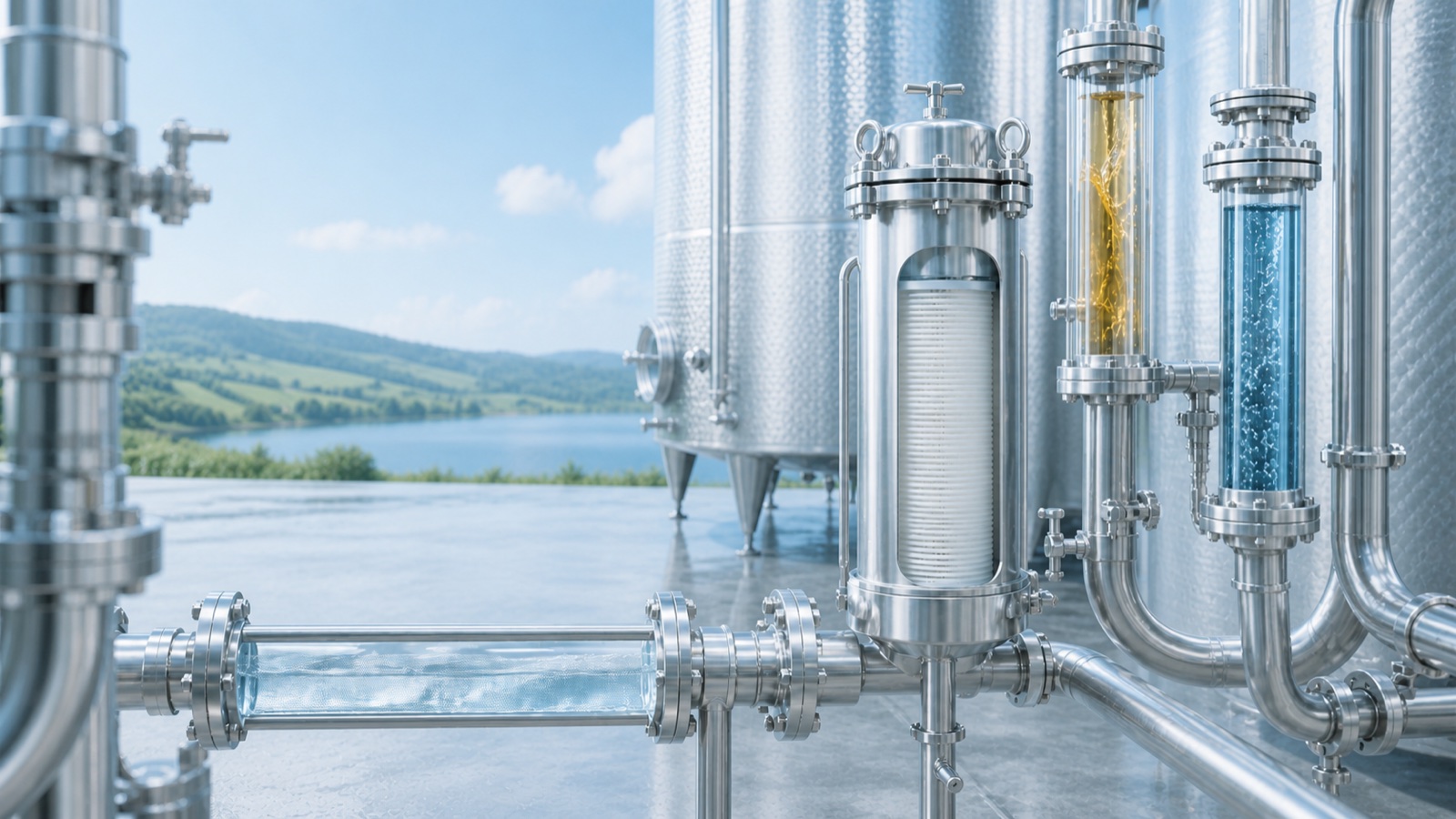
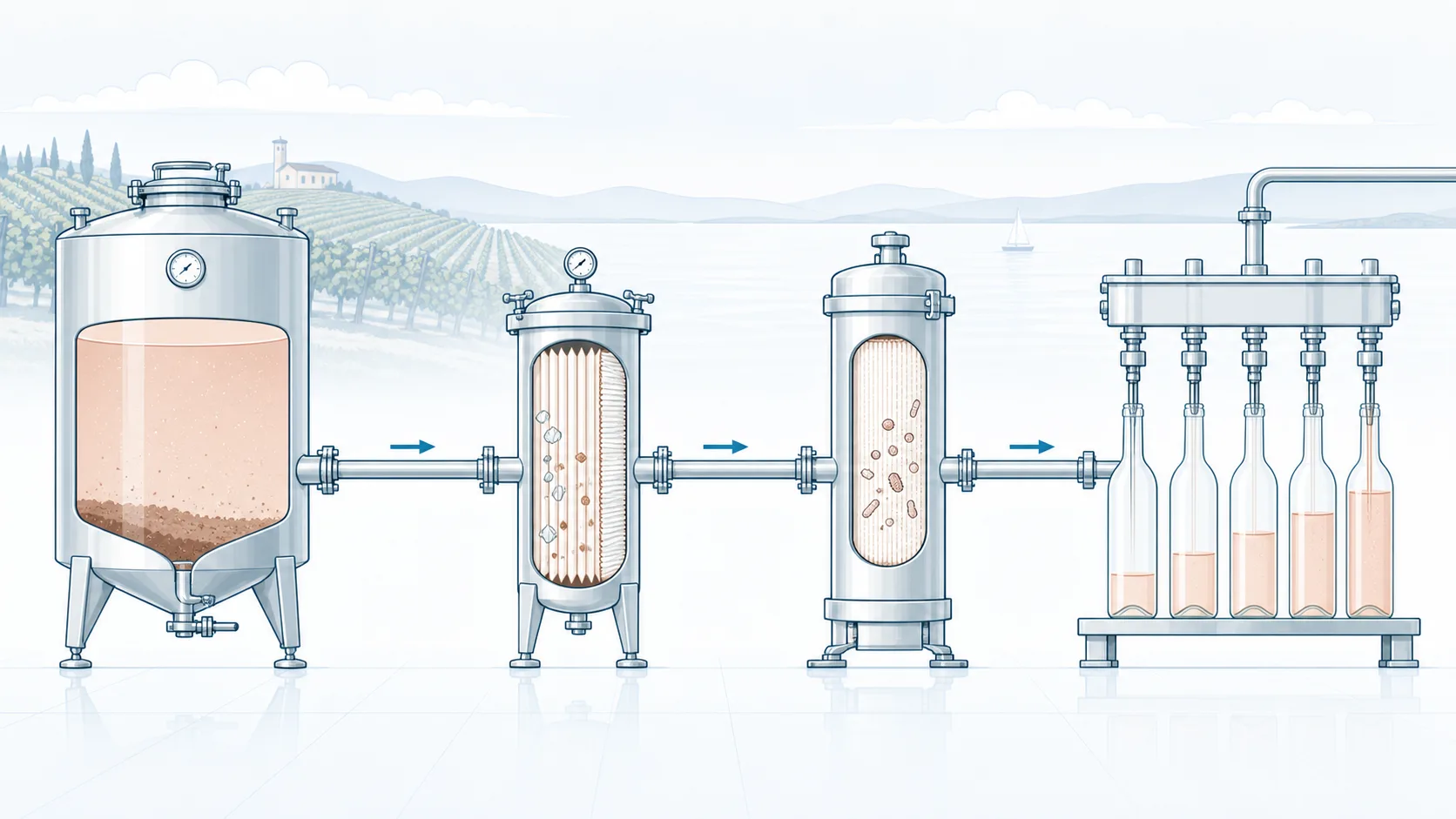
Food and beverage liquids contain intentional ingredients as well as unwanted solids. Filtration must remove defect-causing material without flattening aroma, color, body or nutritional value. Pleated cartridges offer high area for polishing and membrane filtration. Disposable capsule filters are useful for flavors, laboratory batches, dosing streams, low-volume product runs and hygienic point-of-use service. The correct system is normally staged: clarification first, protective prefiltration second and final microbial control only where the process requires it.
A filter is not automatically a sterilization step. Thermal treatment, hygienic design, cleaning, disinfection and contamination control remain essential. When microbial retention is claimed, performance should be validated with organisms relevant to the beverage and the actual fluid conditions; pore size alone does not describe the log reduction achieved.[1]
02 / 08
Wine: Lees, Haze, Crystals and Spoilage Organisms
Young wine may carry grape-skin fragments, seed particles, pulp, bentonite fines and lees composed of dead yeast and grape material. During ageing, protein–tannin complexes and polysaccharides can form haze, while chilling can create potassium bitartrate crystals. Cellar clarification and prefiltration reduce this mixed load before bottling.[2] A fine cartridge installed too early can blind rapidly, causing pressure spikes, product loss and repeated changeouts.
The final concern is microbiological stability. Residual Saccharomyces cerevisiae or S. bayanus can restart fermentation when sugar remains. Dekkera/Brettanomyces and Zygosaccharomyces yeasts, Oenococcus oeni and Acetobacter species can contribute turbidity, off-flavors or instability. Pall identifies these as typical wine spoilage targets for final membrane filtration.[3] Low- and no-alcohol wines are especially demanding because lower ethanol and residual sugar may support microbial activity. Producers must balance organism retention with gentle treatment that preserves aroma and mouthfeel.
03 / 08
Beer, Cider and Fermented Drinks
Beer and cider streams can contain brewing yeast, bacterial cells, hop fragments, grain fines, protein–polyphenol haze, beta-glucan-rich colloids, diatomaceous-earth carryover and activated-carbon fines. Trap cartridges downstream of a DE filter stop filter-aid particles from reaching bright tanks or fillers. A prefilter reduces yeast and haze load before a final membrane. If the upstream clarification step is unstable, the final cartridge becomes an expensive solids collector rather than a controlled microbial barrier.
The production challenge is variability. A cold batch may precipitate more protein haze; a heavily dry-hopped beer may carry more plant material; a sweet cider can support refermentation. Turbidity, differential pressure and microbiological data should therefore be trended by product family, not treated as one universal recipe.
04 / 08
Distilled Spirits and High-Alcohol Products
High alcohol does not eliminate every particle problem. Whisky and other barrel-aged spirits can carry char, wood fibers and cask sediment. Flavored spirits may contain sugar crystals, spice particles, fruit pulp, colorant precipitates or insoluble oil droplets. Carbon treatment can leave activated-carbon fines, and resin columns can release resin beads. A guard-grade pleated cartridge can remove these visible and fine solids before bottling.[4] Capsule filters are practical for small flavor additions or product trials because they provide a closed, compact flow path.
Over-filtration is a real risk. Some haze or oil-associated compounds contribute flavor and mouthfeel. Producers should test the selected media for adsorption, alcohol compatibility and extractables, then define an endpoint based on clarity and sensory results rather than choosing the tightest filter by default.
05 / 08
Juice, Soft Drinks, Tea, Coffee and Syrups
Fruit and vegetable juices contain pulp, peel fibers, seed fragments, starch granules, pectin-rich colloids and protein haze. Tea and coffee beverages may contain leaf or bean fines, precipitated polyphenol–protein complexes and secondary sediment. Sugar syrups can carry undissolved sugar crystals, bag fibers, rust, carbon fines or microbial cells introduced during handling. Flavored soft drinks add emulsified oils, stabilizers and color systems that can be damaged by an overly adsorptive membrane.
These products demonstrate why particle name matters. A rigid seed fragment, a deformable pectin gel and a small yeast cell do not load a filter in the same way. Viscosity, temperature and deformability influence pressure rise and apparent retention. A coarse or depth stage may be needed ahead of the pleated final cartridge, while a capsule can serve a flavor concentrate or dosing skid without exposing the product to a reusable housing.
06 / 08
Bottled Water and Ingredient Water
Source and plant water may contain sand, silt, clay, rust, iron precipitate, manganese oxide, activated-carbon fines, ion-exchange resin fragments, algae debris and biofilm flakes. Bottled-water treatment can include distillation, reverse osmosis, absolute one-micron filtration and ozonation; the FDA notes that absolute one-micron filtration can remove particles larger than one micron, including Cryptosporidium.[5] That statement is process-specific: a cartridge rating and challenge performance must support the intended claim.
A common bottling difficulty is downstream recontamination. Clean water can collect tank scale, gasket fragments or biofilm after the main treatment train. A sanitary final cartridge close to the filler can control particles and, when appropriately validated, microorganisms. Yet it cannot correct a dirty storage tank, an unsanitary vent or inadequate ozone control.
07 / 08
How to Build a Reliable Filtration Train
Start by identifying the defect: visible sediment, haze, premature filter blockage, spoilage or filler wear. Characterize the solids and measure turbidity, particle load and microbiological burden. Use clarification or depth media for high solids; a pleated prefilter for polishing; and a validated membrane only for the final retention duty. Confirm food-contact suitability, temperature and chemical compatibility, steam or hot-water tolerance, integrity-test method and sensory neutrality. Differential pressure limits should be defined before production, not improvised during a blocked run.
08 / 08
Conclusion
Food and beverage cartridge filtration is most effective when it is selective and staged. Wine requires removal of lees, haze and crystals before control of spoilage yeast and bacteria. Beer and cider demand yeast, hop and filter-aid management. Spirits need char, wood and crystal removal without stripping character. Juice, tea, coffee and syrup require gentle handling of fibers, gels and colloids, while bottled water needs control of mineral, corrosion and biological debris near the filler. The result is better clarity, steadier throughput and a defensible quality claim—without pretending that one filter can replace the rest of the hygienic process.
Related search topics
- food and beverage cartridge filtration
- wine membrane filter cartridge
- beer yeast removal filter
- bottled water final filtration
- spirits char removal filter
- juice clarification cartridge
- beverage capsule filter
- Brettanomyces wine filtration
- food grade pleated filter
- haze and sediment removal