

01 / 07
Why Liquid Cleanliness Becomes a Yield Issue
In semiconductor, sensor, display, optical-instrument and precision-equipment production, a particle that is harmless in a utility line can be catastrophic on a patterned surface. Deposited solids can bridge conductors, block a microchannel, scratch a wafer, scatter light or create a weak point in a coating. The practical goal is therefore not simply to make a liquid look clear. It is to prevent the specific particle population in that liquid from reaching the product or a sensitive tool.
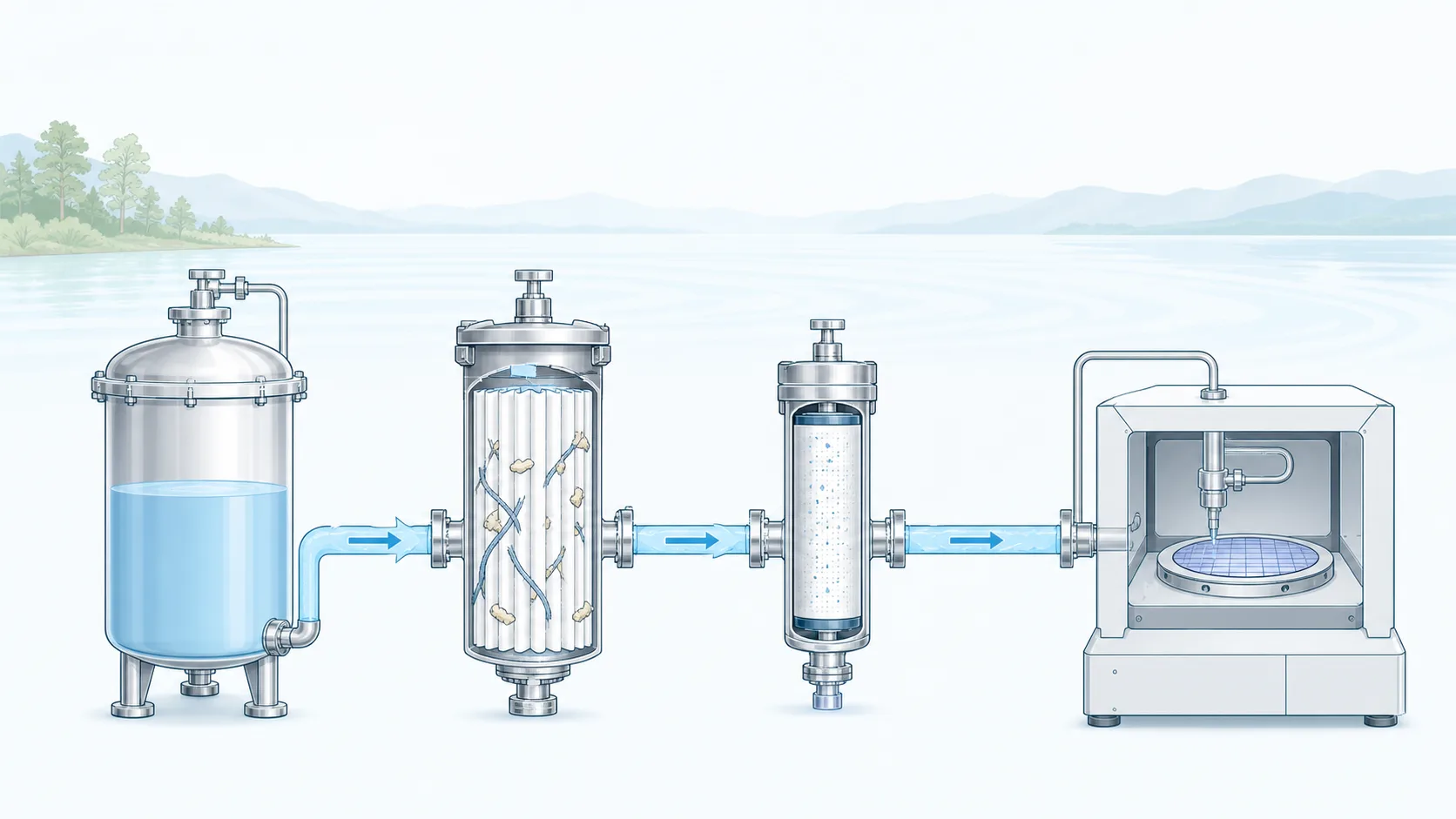
Pleated cartridges provide high surface area in a compact housing and are commonly used for continuous or batch liquid service. A capsule filter combines the filter element and housing in a closed, disposable assembly, which is useful at point of use, in small batches, during sampling and where changeover cleanliness matters. Neither format removes every dissolved contaminant. Membrane chemistry, retention rating, cleanliness, extractables, flow and pressure must match the process.
02 / 07
Ultrapure Water and Precision Rinse Streams
Ultrapure water can carry silica colloids, iron corrosion particles, polymer fragments, ion-exchange resin fines, carbon fines, piping scale and biological fragments. Advanced semiconductor processes also monitor particle precursors: dissolved or colloidal species that can form particles when water dries on a wafer. SEMI notes that high-molecular-weight organics and silicic species may behave this way, while conventional optical counters have difficulty at the smallest dimensions.[1] This is why final point-of-use filtration is paired with upstream water purification and particle monitoring rather than treated as a stand-alone cure.
A common production difficulty is “clean filter, dirty start.” A filter may meet its retention target but release manufacturing debris or require a long rinse before particle counts stabilize. Initial cleanliness, rinse-up volume and low extractables are therefore as important as nominal pore size. For high-purity tools, the filter must also tolerate sanitization and avoid adding ions or organic extractables.
03 / 07
Wet Chemicals, Photoresist and Optical Coatings
Acids, bases, solvents, developers, photoresists and optical-coating liquids can contain packaging debris, drum or tote particles, precipitated salts, polymerized skins, microgels, fibers, elastomer fragments and particulate metal oxides. In photochemicals, gels and partially polymerized resin can create coating streaks, pinholes or pattern defects. In aggressive acids and solvents, compatibility is a central challenge: an unsuitable membrane, support layer, seal or housing can swell, shed, leach or lose retention.[2] Hydrophilic or hydrophobic media, fluoropolymer construction and seal materials should be chosen from actual chemical and temperature data.
Filters should be staged. A protective prefilter captures larger fibers and gel fragments; a finer point-of-use membrane handles the critical particle range. Installing only an ultrafine final filter on a high-gel fluid often causes rapid pressure rise, short service life and unstable flow.
04 / 07
CMP Slurry: Remove Defects Without Removing the Process
Chemical mechanical planarization slurry intentionally contains functional silica, ceria or alumina abrasive particles. The unwanted fraction is different: oversized agglomerates, dried slurry flakes, foreign fibers, tank debris and hard gels. Agglomerates above the intended particle distribution can generate microscratches, while overly tight or adsorptive filtration can strip useful abrasive or alter slurry chemistry.[3] The filtration task is selective: reduce large-particle count while preserving the working slurry concentration and polishing behavior.
This stream also punishes poor system design. Low-flow zones allow settling; pump shear can create or break agglomerates; recirculation repeatedly loads the same filter. Testing should compare differential pressure, large-particle count and polishing performance over realistic recirculation time.
05 / 07
Equipment Cooling, Cutting and Assembly Fluids
Precision equipment cooling loops and aqueous cleaning fluids collect rust, copper oxide, calcium carbonate scale crystals, machining fines, seal fragments, dust and biofilm flakes. These particles can block narrow channels, foul heat exchangers, score pump seals or redeposit on components. Pleated cartridges are often used as side-stream or full-flow protection. Small capsule filters can protect a dosing line, analyzer or final rinse point. Dissolved hardness, ionic contamination and viable growth still require chemical control, ion exchange, ultraviolet treatment or other appropriate processes; particle filtration alone does not solve them.
06 / 07
Selection Argument: Define the Defect Before the Micron Rating
A defensible specification starts with microscopy, particle counting or failure analysis: What is the particle made of? Where is it generated? What size causes the defect? Is the liquid aqueous, solvent-based, acidic or abrasive? The answers determine whether a depth prefilter, pleated membrane cartridge or closed capsule is appropriate. SEMI’s sub-15-nanometer UPW guidance even uses colloidal silica challenges and considers both retention and the filter’s initial particle contribution.[4] That illustrates the larger rule: a pore-size label is not a complete performance claim.
07 / 07
Conclusion
Effective electronics manufacturing filtration is a contamination-control chain. In ultrapure water it manages colloids, resin fines and corrosion debris; in photochemicals it targets particles and gels; in CMP it removes oversized agglomerates without damaging the slurry; and in equipment fluids it protects narrow passages from scale and wear debris. The best pleated cartridge or capsule filter is the one validated against the real fluid, real defect and real operating cycle—not simply the smallest available micron rating.
Related search topics
- electronics manufacturing liquid filtration
- semiconductor process filtration
- ultrapure water particle filter
- photoresist capsule filter
- CMP slurry filtration
- pleated filter cartridge for electronics
- point-of-use chemical filtration
- silica colloid removal
- microgel filtration
- precision equipment coolant filtration