
01 / 07
What High-Flow Filtration Actually Does
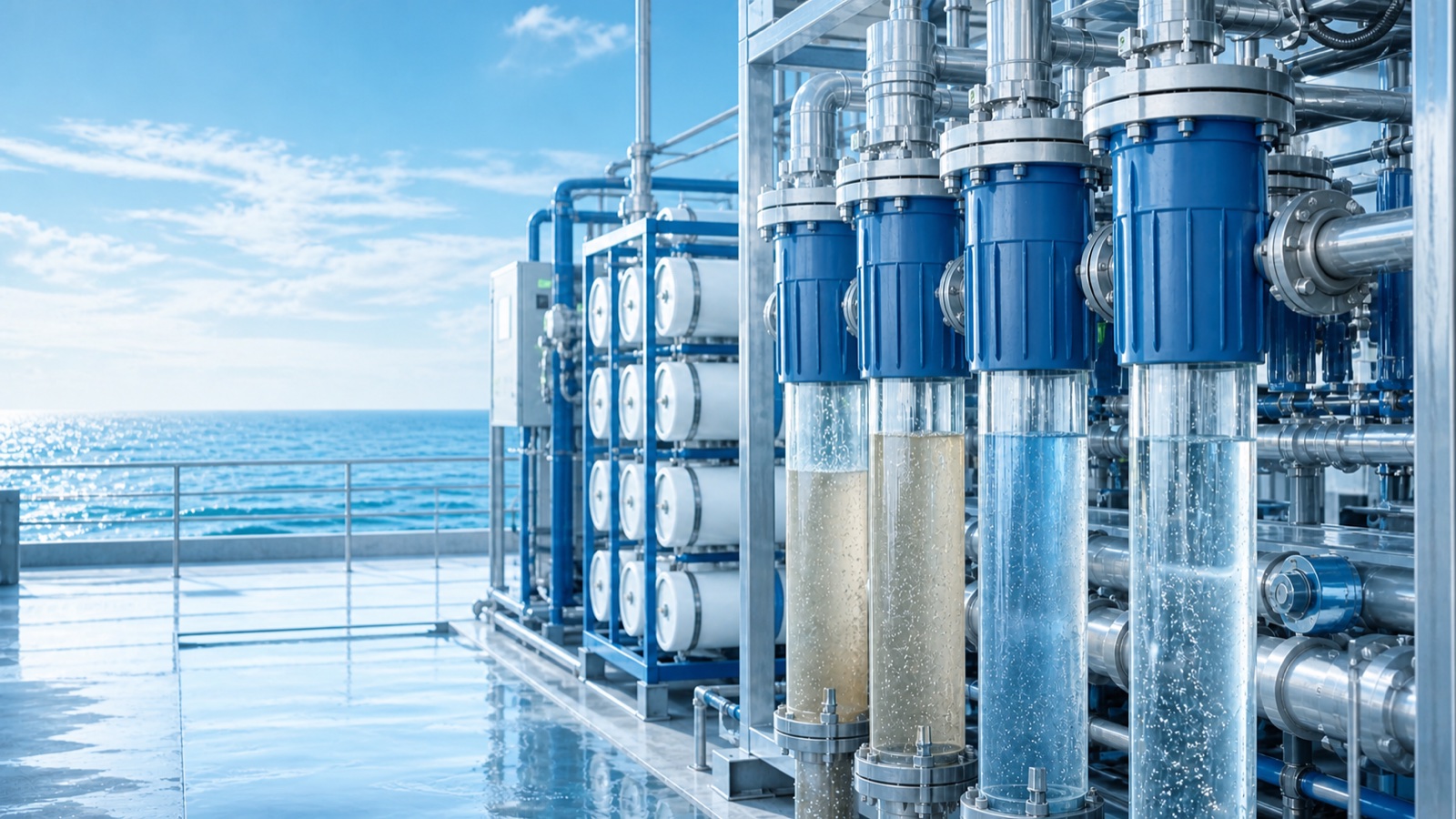
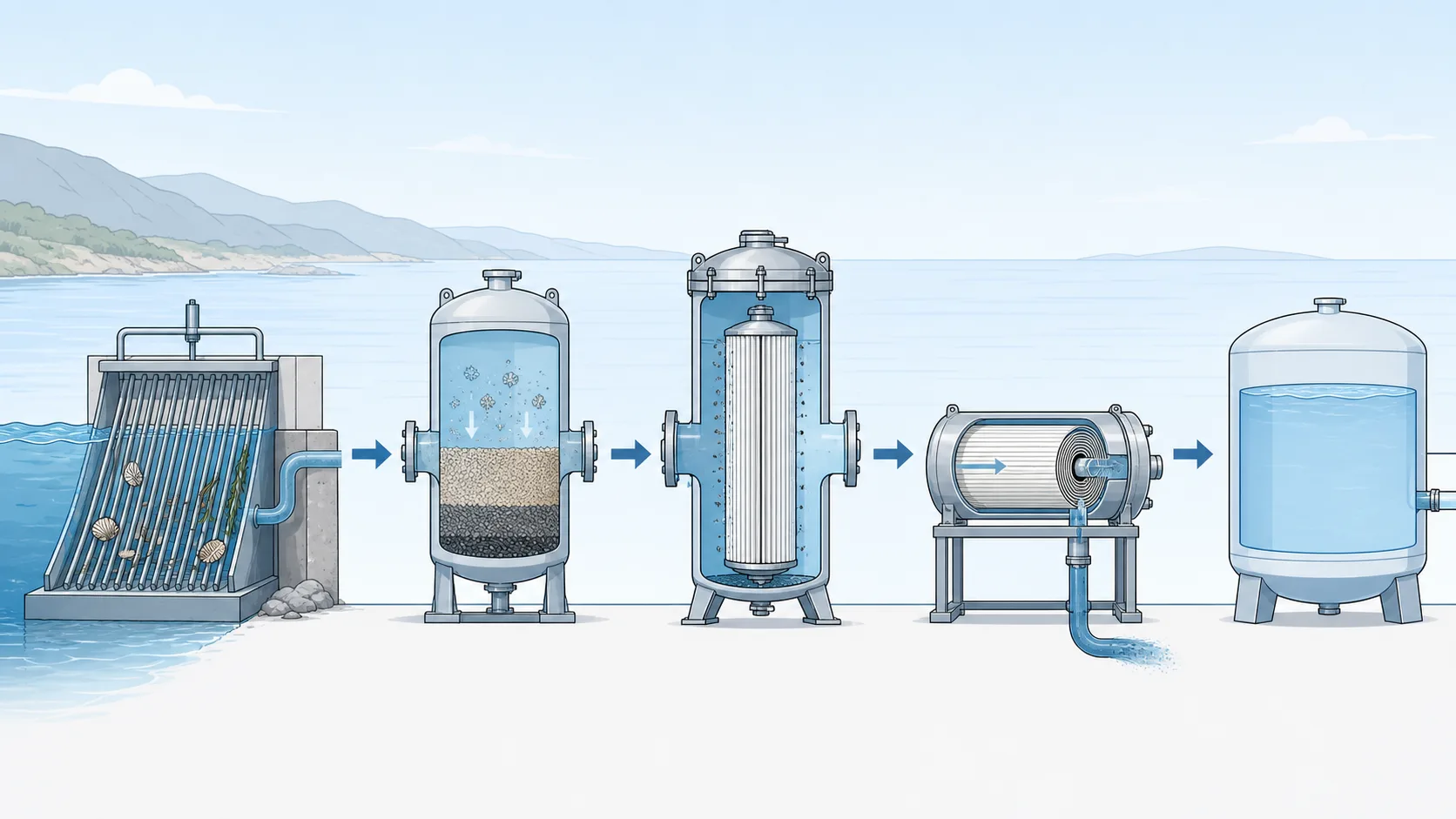
High-flow pleated cartridges combine large media area with an inside-out or outside-in flow path designed for substantial water throughput in a compact housing. They are used after screens, clarification, media filtration, microfiltration or ultrafiltration and before reverse osmosis, heat exchangers, nozzles or reuse equipment. Their purpose is usually to catch remaining suspended solids and process upsets, not to perform desalination itself.
Capsule filters occupy a different scale. A capsule may protect an analyzer, sample line, chemical-dosing stream or small point of use, but it is rarely the primary device for a municipal or seawater plant’s full flow. Clear application language prevents customers from expecting a small disposable capsule to carry a massive solids load.
02 / 07
Seawater Desalination and Reverse-Osmosis Pretreatment
Raw seawater can contain sand, silt, clay, shell fragments, plankton, algae, bacterial flocs, organic detritus and corrosion particles. Storms, tides and algal blooms can change this load quickly. Pretreatment chemicals may create ferric or aluminum hydroxide flocs; if poorly captured, those solids become downstream foulants. A high-flow cartridge near the RO skid acts as a final guard against media breakthrough, pipe debris and transient particles.
DuPont identifies bacteria, clay, colloidal silica and iron corrosion products as common sources of silt and colloids in RO feedwater.[1] Pall has reported RO problems associated with silt in the 2–63 micrometer range and algae components that passed conventional cartridge pretreatment.[2] The lesson is not that one tighter cartridge solves every seawater problem. Intake screening, coagulation, dissolved-air flotation, media filtration or membrane pretreatment may be required to control the load before the guard cartridge.
Dissolved sodium and chloride pass through a particulate cartridge and are rejected later by RO. Dissolved silica also passes until it polymerizes or becomes colloidal. Scale species such as calcium carbonate, calcium sulfate, barium sulfate and calcium fluoride are captured only after precipitation; chemistry and antiscalant control are needed to prevent deposition.
03 / 07
Drinking Water and Industrial Process Water
Surface water can carry clay, silt, algae fragments, pollen, organic floc and microorganisms. Groundwater may produce iron hydroxide, manganese oxide and mineral scale when exposed to oxygen or a pH change. Plant distribution systems add rust, cement lining debris, activated-carbon fines and ion-exchange resin fragments. EPA materials describe filtration as a way to remove suspended solids and some microbes after upstream treatment.[3]
High-flow cartridges are useful as polishing filters before RO, electrodeionization, boiler make-up, beverage water, cooling towers and spray nozzles. Their challenge is variability: a clarifier upset or tank-cleaning event can multiply solids load and collapse service life. Plants should trend turbidity, particle count, Silt Density Index where relevant, differential pressure and filter-change frequency. A sudden pressure-rise pattern is often evidence of an upstream problem, not simply a request for a larger housing.
04 / 07
Municipal Wastewater and Reuse
Secondary effluent can contain activated-sludge flocs, bacterial cells, extracellular polymeric material, hair and textile fibers, cellulose, microplastic fragments, grit fines and precipitated solids. Chemical phosphorus removal can add aluminum, iron or lime precipitates. EPA describes tertiary filtration as removal of residual biological floc and precipitates from alum, iron or lime treatment.[4] A high-flow cartridge can polish already clarified effluent or protect UV systems, reuse membranes and industrial users.
Untreated sewage is normally too dirty for a fine pleated cartridge. Rags, paper, plastics, metal objects, sand and gravel belong in screens and grit-removal systems. A cartridge placed before those stages will block quickly and create excessive waste. Even after secondary treatment, deformable biological flocs may penetrate or compress differently from rigid test dust, so pilot data under real flow conditions are valuable.
05 / 07
Industrial Wastewater and Cooling Systems
Metal-finishing wastewater may contain iron oxide, zinc or nickel hydroxide precipitates and polishing fines. Pulp and paper streams can carry cellulose fibers and coating pigment. Food plants may release starch granules, fat-associated solids and biological floc. Cooling-water loops collect rust, scale crystals, airborne dust, algae and biofilm fragments. In each case, the dissolved fraction—metal ions, salts, sugars, surfactants or chemical oxygen demand—cannot be assumed to disappear across a particulate filter.
High-flow cartridges work best as equipment protection or final polishing after the bulk separation step. Side-stream filtration can control recirculating cooling-water debris, while full-flow guard filtration protects small heat-exchanger passages. Media and seals must match oxidants, temperature, pH and cleaning chemistry.
06 / 07
How to Specify a High-Flow Filter
Begin with source-water data and the downstream sensitivity. Identify the solids through microscopy, ash analysis or elemental methods when failure cost justifies it. Define the required retention as nominal or absolute with an understood test method. Then size total media area for clean pressure drop, peak flow, viscosity, solids load and acceptable terminal differential pressure.
Filter construction should be evaluated for collapse resistance, bypass sealing, extractables and disposal volume. If an RO plant needs consistent feed quality, combine cartridge data with turbidity and SDI trends. A cartridge that lasts longer because it allows damaging particles through is not an improvement; a cartridge that blocks daily may be exposing inadequate pretreatment. The objective is stable downstream operation at the lowest defensible lifecycle cost.
07 / 07
Conclusion
High-flow water filtration controls the suspended fraction: sand, silt, clay, algae debris, biological floc, rust, corrosion products, precipitated scale, resin fines and process carryover. In desalination it protects RO after upstream pretreatment. In drinking and industrial water it polishes feed for sensitive equipment. In wastewater reuse it captures residual biological and chemical flocs after clarification. It does not remove dissolved salts, most dissolved organics or every pathogen. The best system therefore combines a correctly rated pleated guard filter with screening, clarification, membrane treatment, disinfection and chemistry control appropriate to the source water.
Related search topics
- high-flow water filtration
- desalination cartridge filter
- RO pretreatment filter
- seawater silt removal
- wastewater polishing cartridge
- high flow pleated filter
- iron corrosion particle removal
- cooling water side stream filtration
- SDI protection filter
- industrial water cartridge filtration