
02 / 10
KEY FEATURES
Construction and performance
- Double-layer hydrophilic PES membrane
- High dirt-holding capacity and clogging resistance
- High flow with low pressure drop
- Low protein binding
- Low extractables
- All-polypropylene construction
Puretratech · PT69SPSTMS
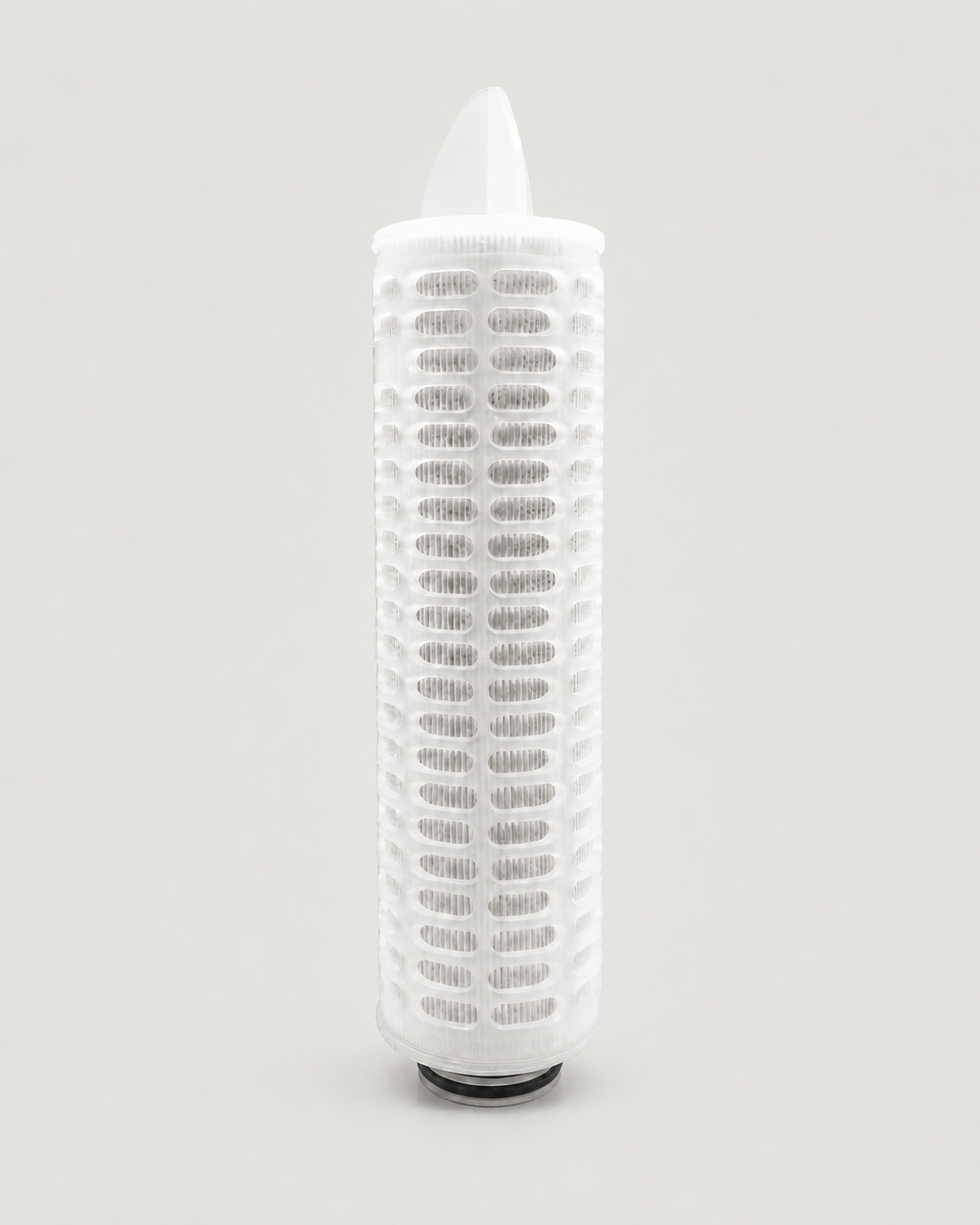
A double-layer hydrophilic polyethersulfone (PES) membrane provides high dirt-holding capacity, clogging resistance, high flow, low pressure drop and low protein binding for sterilizing filtration of high-value biological products and vaccines.
01 / 10
Designed for low-binding, high-value fluid filtration
The PT69SPSTMS sterilizing-grade cartridge combines a double-layer hydrophilic polyethersulfone (PES) membrane with an all-polypropylene construction.
The dual-layer membrane design increases dirt-holding capacity and throughput while reducing the risk of premature clogging. It also delivers broad chemical compatibility, low extractables and exceptional flow rates at low pressure drops.
The low-binding nature of the PES membrane minimizes product loss through adsorption, making the cartridge especially well suited to high-value biologicals, vaccines and protein-containing solutions.
02 / 10
Construction and performance
03 / 10
Typical process uses
04 / 10
Materials of construction
Structured text sourced from the submitted workbook.
| Component | Material / method |
|---|---|
| Filter membrane | Double-layer polyethersulfone (PES) membrane |
| Media support | Polypropylene (PP) |
| End caps | Polypropylene (PP) |
| Inner core | Polypropylene (PP) |
| Outer cage | Polypropylene (PP) |
| Sealing method | Thermal bonding |
| O-rings | Buna-N, Viton/FKM, EP, Silicone, encapsulated Silicone or encapsulated Viton/FKM |
05 / 10
All components meet the biological-safety requirements of USP Class VI at 121 °C for plastics.
06 / 10
Materials of construction comply with FDA regulations for food and beverage contact use, as detailed in Title 21 of the U.S. Code of Federal Regulations (21 CFR). Materials used to produce the filter media and hardware are safe for use in contact with foodstuffs in accordance with EU 10/2011.
07 / 10
Operating limits
08 / 10
Cycle conditions
09 / 10
Minimum bubble point by pore size. Values are transcribed from the submitted image.
| Pore size | Minimum bubble point |
|---|---|
| 0.2/0.2 µm | 55.1 PSI / 3.8 barg (Water) |
| 0.45/0.2 µm | 55.1 PSI / 3.8 barg (Water) |
| 0.8/0.45 µm | 39.2 PSI / 2.7 barg (Water) |
10 / 10
The table uses one dynamic column per code segment and one “company code=product meaning” expression per option. Row count follows the longest column.
| Series code | Pore size | Length | Endcaps | Seal | Connection support |
|---|---|---|---|---|---|
| SPSTMS | 0021=0.2/0.1µm | 05=5 inch | 7=226/fin | B=Buna-N | S=SS reinforcement |
| 0022=0.2/0.2µm | 10=10 inch | 6=226/flat | E=EPDM | ||
| 0024=0.45/0.2µm | 20=20 inch | 0=222/flat | S=Silicone | ||
| 0026=0.65/0.2µm | 30=30 inch | 5=222/fin | V=Viton | ||
| 0046=0.65/0.45µm | 40=40 inch | F=DOE | |||
| 0086=0.8/0.65µm | 2=224/fin | ||||
| 3=224/flat | |||||
| 4=222/fin (3 lugs) | |||||
| 8=222/flat (3 lugs) | |||||
| x=213 internal O-ring |